
Live webinar presented by Dr. Sherif Soliman and Jason St. Aubin, JD
Resources
Improving Analysis of “Trace DNA” Evidence
NIJ report on use of direct PCR which may eliminated the loss of DNA that traditionally occurs during DNA extraction and quantitation
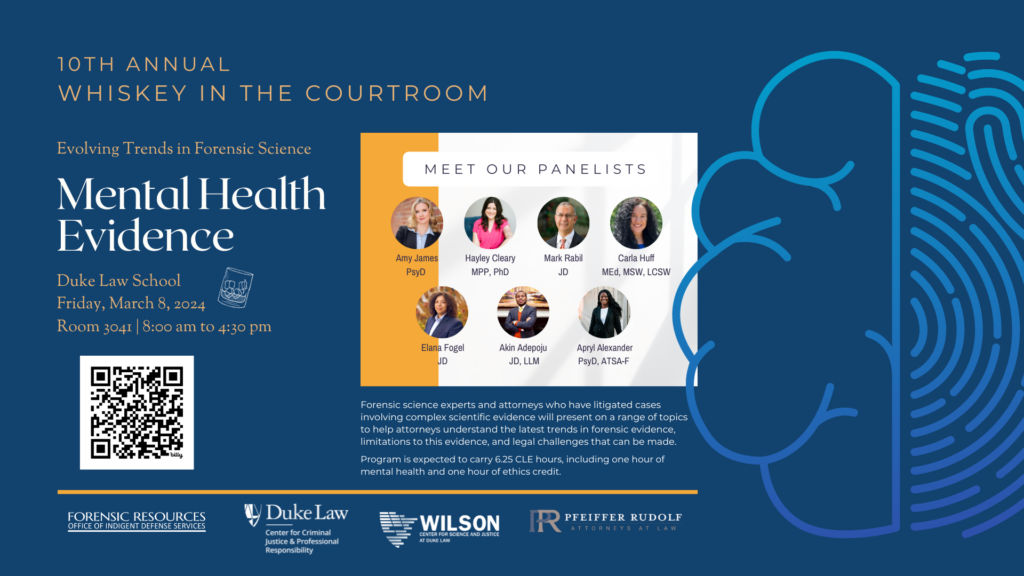
Whiskey in the Courtroom CLE – Evolving Trends in Forensic Science: Mental Health Evidence
Indigent Defense Services, the Duke Law Center for Criminal Justice and Professional Responsibility, and the Wilson Center for Science and Justice are pleased to announce the 10th annual CLE, “Whiskey in the Courtroom: Evolving Trends in Forensic Science.” “Whiskey 10” will take place March 8 at Duke Law School. Forensic science experts and attorneys who have …
Whiskey in the Courtroom CLE – Evolving Trends in Forensic Science: Mental Health EvidenceRead More
Guilty Until Proven Innocent: Field Drug Tests and Wrongful Convictions
This report by the Penn Carey Law Quattrone Center provides the first-ever comprehensive analysis of presumptive drug field test usage across law enforcement agencies in the United States. Inexpensive and fast, these tests have become a tool of choice for law enforcement agencies. Unfortunately, they are notoriously imprecise and are known to produce “false positives,” …
Guilty Until Proven Innocent: Field Drug Tests and Wrongful ConvictionsRead More
Judging Firearms Evidence
Making Sense of Science: Forensic Science & the Law
3-day training offered by NACDL in Las Vegas
Making Sense of Science: Forensic Science & the LawRead More
A Lawyer’s Guide to Vehicle Forensics
Free webinar offered by NACDL
Ethics Opinion: The Field of Firearms Forensics is Flawed
Article: Scientific Guidelines for Evaluating the Validity of Forensic Feature-comparison Methods
Article: (Mis)use of Scientific Measurements in Forensic Science
Article: Confronting an Upsurge in Opiate Deaths with Limited Resources
The study, published in 2017, by Thomas Andrew and Jennie Duval suggests that as many as 5% of drug overdose deaths are misclassified as such when a full autopsy is not performed. This is because the internal examination would have revealed a different, more likely cause of death.
Article: Confronting an Upsurge in Opiate Deaths with Limited ResourcesRead More
Article: Correctly Identifying Deaths Due to Drug Toxicity Without a Forensic Autopsy
This study, published in 2019 by Daniel Dye, et al. suggests that 15-20% of drug overdose deaths are misclassified as such without a full autopsy.
Article: Correctly Identifying Deaths Due to Drug Toxicity Without a Forensic AutopsyRead More
Online Course: Exploiting Forensic Evidence’s Tenuous Link to Science
Offered by NAPD. Cost is $325 and scholarships are available through NAPD.
Online Course: Exploiting Forensic Evidence’s Tenuous Link to ScienceRead More
Virtual Workshop Series: Qualifications of an Expert Witness for Legal Professionals
Free to attend virtual workshop offered by FTCOE and NC State University
Virtual Workshop Series: Qualifications of an Expert Witness for Legal ProfessionalsRead More
People In Forensic Department
Lab Analyst Table