
Drug analysis is the testing of a suspected controlled substance to determine its composition. For information about forensic toxicology, or the testing of bodily fluids for controlled substances, click here.
Understanding Test Results
Every analysis of a suspected controlled substance should consist of at least two tests. The first is a presumptive or screening test which indicates if the sample could be a controlled substance. Substances other than controlled substances may produce positive results with these presumptive tests (false positives). Therefore, confirmatory tests that are substance-specific must be performed in order to positively identify the substance. The State Crime Lab’s procedures divide drug testing techniques into three categories and describe what combinations of tests must be performed. The State Crime Lab’s Technical Procedure for Drug Chemistry Analysis provides helpful flow charts that show which tests are used to analyze suspected controlled substances.
Explanation of Testing Procedures
Detailed descriptions of the tests used to analyze suspected controlled substances and their limitations are contained in the expandable sections below.
Presumptive Tests
- Instructional Videos for Chemical Color Tests:
- The Home Scientist – Forensic Presumptive Drug Testing
- Ohio University Forensic Chemistry Lab – Chemical Color Tests
- Concerns for color tests: (1) False positives. Some over the counter cold medication or other substances may test positive for illegal substances using presumptive color tests. Because some drugs behave similarly, a confirmatory test is needed. (2) Color tests may only give an indication of a class of drug present. (3) A color test cannot conclusively identify the presence of a substance.
- Case Law: In State v. Carter (2014), the NC Court of Appeals found the trial court abused its discretion by allowing an officer to testify that a narcotics indicator field test kit indicated the presence of cocaine on items of evidence where the State failed to demonstrate the reliability of the kit.
- To reduce the variability in results due to subjective analysis, good laboratory practices include running a positive control for visual comparison with the evidence sample.
- A lab report from the State Crime Lab will only include the name of the test and the resulting color. The Lab does not use a color standard for comparison or a photo or video to record the result.
- Law Enforcement and Corrections Standards and Testing Program – National Institute of Justice provides standards for color test reagents and kits for the preliminary identification of controlled substances. Attorneys can use this publication to look up a color test and see what substances produce which color changes.
- Helpful questions to consider: Was the required quality control check performed? The reagent lasts for only X days – do you know the age of the reagent? How was the resulting color measured – was it compared to a color standard or simply eye-balled? Was the resulting color recorded (photographed)? What precautions were taken to avoid cross-contamination? If performed by a law enforcement officer, what training does he/she have to perform this test?
- Law enforcement officers may use color tests to check for controlled substances while in the field. They typically use a kit that is produced commercially, for example, by NC company Sirchie. Below are the names of some of the color tests that might be used in the kit or in a lab:
- Marquis Reagent
- Cobalt Thiocyanate Reagent (Scott’s Test)
- Duquenois-Levine
- Ferric Chloride
- Koppanyi
- Potassium Permanganate
- Ehrlich’s, Van Urk’s, or p-dimethylaminobenzaledhyde (PDMAB)
- Froehde’s
- Mecke’s
- Other tests
Includes techniques (visual examination and microscopic examination) to understand the physical properties and characteristics of substances.
- Visual Examination – for pills, the State Crime Lab identifies a pharmaceutical preparation by physical characteristics and markings and through instrumental analysis of one pill. This means the pill is compared to pictures and descriptions in reference materials such as Micromedex, The Physician’s Desk Reference, The Logo for Tablets and Capsules or websites. Visual examination is to be used for preliminary examination only. In State v. Ward the NC Supreme Court held that visual identification of controlled substances is not reliable enough to be admitted in criminal trials, and that a chemical analysis is required. For further discussion see the various posts on the subject on the NC Criminal Law blog. SWGDRUG allows pharmaceutical indicators as a class B identification of pills. This means that 2 other identification methods are necessary in order to positively identify a pill as a controlled substance.
- Concerns: Pills produced in clandestine labs rather than in a pharmaceutical lab are common. It may be difficult to distinguish a pharmaceutical preparation from a clandestine lab pill.
- Microscopic examination – using a microscope to examine the characteristics and properties of a substance too small for the naked eye.
- Polarized light microscopy – contrast-enhancing technique that improves the quality of the image obtained by equipping these microscopes with a polarizer and an analyzer (second polarizer).
- Microcrystalline test – a substance reacts with a reagent forming an insoluble crystal. The shape of the crystal suggests the type of drug. These tests are rapid and do not require the isolation of the drug prior to testing.
- Polarized light microscopy with microcrystalline tests can be used to presumptively identify drugs. The following list indicates various reagents that can be exposed to the drug for analysis using the microcrystalline test with microscopy.
- Heroin and caffeine: mercuric chloride, hydrochloric acid
- Barbiturates: Wagenaar reagent (cupric sulfate), sodium hydroxide, sulfuric acid
- Cocaine and phencyclidine (PCP): gold chloride in acetic acid, hydrochloric acid
- Plant particles from marijuana, hashish: concentrated sodium hydroxide, petroleum ether, chloroform, chloral hydrate
- Amphetamines and methamphetamines: gold chloride in water, gold chloride in phosphoric acid, sodium hydroxide
- Concerns: (1) Impurities may cause unusual crystal formation. (2) Check reagents with known standard of drug before performing an actual procedure. (3) Proper storage of reagents.
- Macroscopic examination – examining the properties and characteristics of the substance that are observable by the naked eye.
- For descriptions and images of illegal drugs, see the following sources:
- DEA Resource for Parents – provides images of drugs of abuse and information about the effects and legal status of drugs.
- For descriptions and images of illegal drugs, see the following sources:
- For Marijuana – the State Crime Lab cannot distinguish between hemp and marijuana at this time. Quantitative determination of %THC levels are required by statute. The lab does not have the procedures, instrumentation, and resources to determine the %THC levels in a substance. Private labs do provide this service.
Confirmatory Tests
- Characteristics
- Specific
- Considered the “gold standard” of drug identification
- Most definitive and reliable of the confirmatory tests
- How it works
- GC
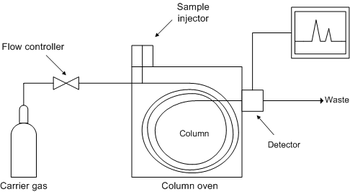
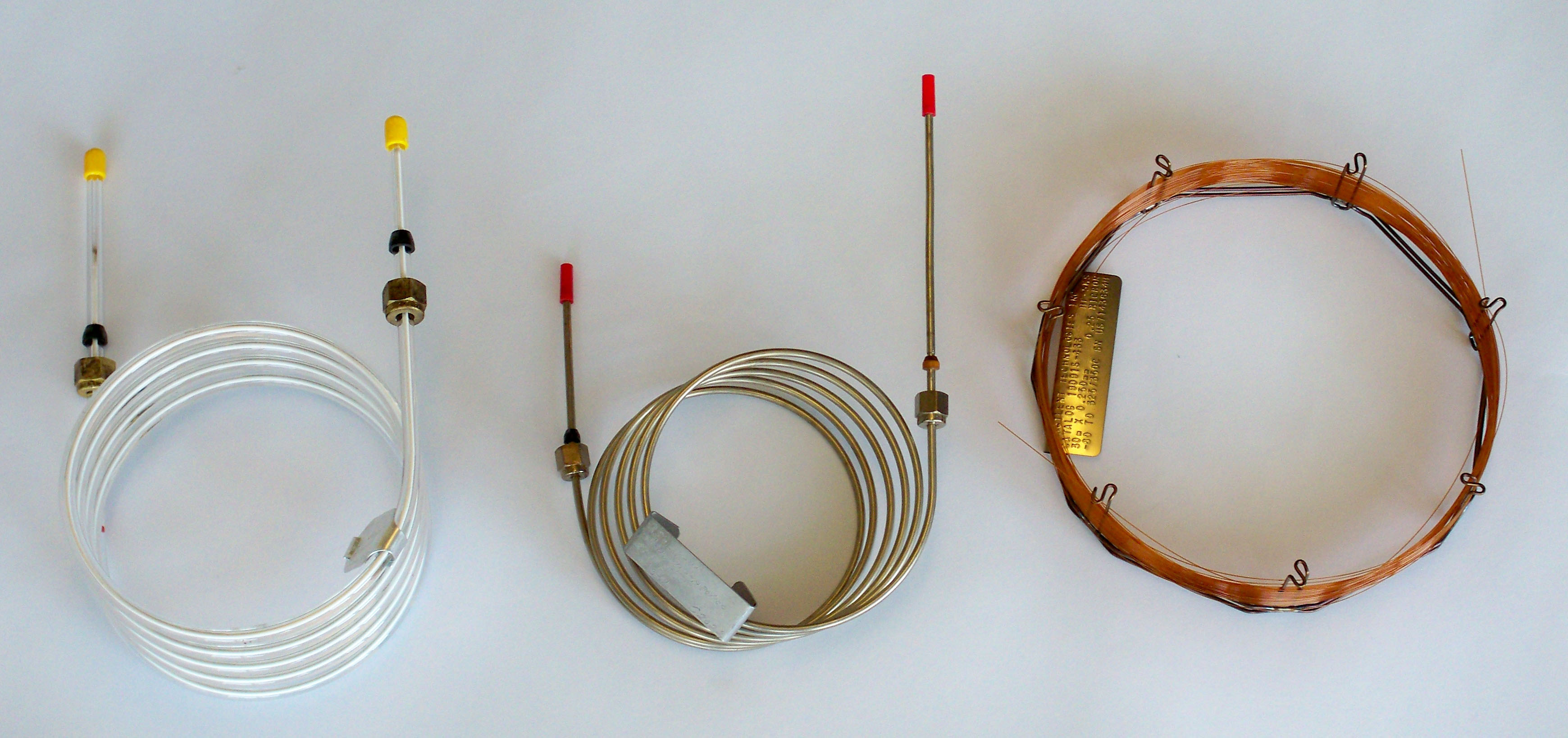
- A sample is injected via a port into the gas chromatograph and converted to gas form (vaporized). The vaporized sample is then transported by helium gas through a long coiling column. The column is then subjected to varying temperatures which results in the separation of compounds based on volatility (how easily a substance can be vaporized). Eventually, all molecules will reach the end of the column where they enter the detector. After detection, a computer program will generate a chromatogram, which will show peaks for each of the molecules separated by the GC. The higher the quantity of molecules of the same kind that reach the detector, the higher the peak for that molecule will be.
- The amount of time it takes for a molecule to move through the entire machine and be detected by the detector is called the retention time. Analysts may use retention times to differentiate between different compounds. However, the retention time alone are not conclusive indicators of what compound is present. A specific compound will have a known retention time, but multiple compounds may have the same retention time in the same chromatogram. In order to distinguish and identify which compounds made the peaks, a mass spectrometer is used.
- MS
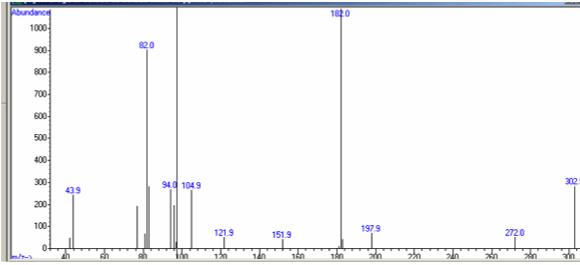
- A mass spectrometer will determine the exact molecular weight of a molecule or compound. A previously separated sample (flowing directly from GC after detection) must be ionized for mass spectrometry. The sample, now broken down into molecules, is subjected to an ionization source, a beam of steadily flowing electrons, which blasts the molecules and causes them to break apart into positively charged particles, or ions. Only positively charged ions will continue through the machine. Next, the ions travel through the mass analyzer, or quadrupole filter. The mass analyzer uses an electromagnetic field to separate the ions based on molecular weight. In a routine drug analysis performed by the laboratory, the analyst will already know the molecular weights of the drugs that are frequently detected. To isolate these specific drugs at their known molecular weights, the scientist will manipulate the experimental environment (such as flow rate, type of gas used, temperature, etc.) in previously tested and scientifically accepted ways to produce the range of molecular weights required for analysis. This manipulation will allow only ions between the desired molecular weights to pass through the machine. Ions that flow through the mass analyzer without being filtered will reach the mass detector. The mass detector will count the number of ions with a specific mass. These detections will be translated by a computer program into a mass spectrum.
- Together
- A chromatogram (from the GC) and a spectrum (from the MS) can be used together to determine a molecule’s identity. Solely using GC results to identify a compound may lead to inaccurate conclusions. As mentioned earlier, a molecule will have a specific retention time, but a specific retention time does not identify a specific molecule. The analyst will use the spectra to determine the molecular weight of the molecule that generated the peak at a specific retention time. The molecular weight at that retention time will eliminate incorrect identities and narrow down the potential identities to one. The retention time, molecular weight, and patterns of both the chromatogram and spectrum must all match a known standard to be conclusively identified. Differences should not be disregarded unless specifically permitted in the lab procedures.
- GC
- Limitations
- A mass spectrometer cannot distinguish between compounds in mixed samples. A sample must be separated prior to MS testing. A gas chromatograph is used to separate the impurities out of a sample in preparation for mass spectrometry. The mass spectrometer will measure the atomic weight of the compounds that were separated by the gas chromatograph.
- MS cannot differentiate between molecules that have the same molecular weight but have chemical structures that are mirror images (also known as enantiomers). This is the case specifically with pseudoephedrine and ephedrine. Subsequent FTIR testing may be necessary to distinguish enantiomers.
- GC/MS will detect the presence of methamphetamine, however, it will not differentiate between methamphetamine stereoisomers. L-Methamphetamine is the active ingredient in the over-the-counter cold medication Vick’s VapoInhaler and other generic preparations. This ingredient is completely legal. It is commonly labeled as levmetamfetamine to signify that is the legal form of methamphetamine. The other isomer, D-Methamphetamine, is not legal, but will create the exact same peaks on a GC/MS as the L-form does. It is important for the lab to quantitate how much of each stereoisomer are present, which can be done by means of percentages. Some laboratories will allow up to 20% of the D isomer to be present before reporting positive test results for illegal methamphetamine. This blog post explains the concepts of chirality and stereochemistry as they apply to GC/MS testing of suspected methamphetamine.
- If a sample contains a high concentration of pseudoephedrine or ephedrine, it is possible for an “artifact peak” to appear on a GC/MS chromatogram. If not correctly identified as an artifact peak, the sample may be misidentified as methamphetamine. This peak is created by a reaction at the injection point under certain experimental conditions. At higher temperatures (see Hornbeck et al, “Detection of GC/MS Artifact Peak as Methamphetamine,” Journal of Analytical Toxicology (1993) which determined that at 300 degrees an artifact peak existed, while at 185 degrees it did not) pseudoephedrine and ephedrine will react with 4-carboxyhexafluorobutyrl, pentafluoropropionyl, heptafluorobutyryl, and a few other substances to create an artifact peak that is similar to that of methamphetamine. This artifact peak can be eliminated by adding sodium periodate to the urine sample before GC extraction.
- Malfunctions in the equipment can occur. The injection point septum is a part of the machine that has the potential to wear. This port only lasts 100-200 injections. The injection port temperature, which is selected by the analyst, may be high or low causing a shortened septum life span, decreased sensitivity, poor separation of liquid material, or decomposition of the sample.
- Considerations
- Is the machine is properly maintained and calibrated? Were the samples prepared properly by the analyst? Are any reagents out-of-date? Were negative controls, positive controls, and blanks properly used? Was the analyst following the protocol properly?
- Did the analyst perform an individualized interpretation or did s/he rely on the computer generated comparison to the library of standards?
- Interpretation of only the chromatogram (chart generated by the gas chromatograph) or a spectrum (chart generated from the mass spectrometer) is not sufficient. Both the chromatogram and spectrum must be interpreted together and a final identification must be supported by both.
- Characteristics
- Highly specific.
- Many substances will create an unequivocal IR spectrum that is easily identifiable by analysts.
- An IR spectrum by itself does not provide an exact chemical structure of a compound, but will provide information about functional groups that are present in the molecule.
- Presence or absence of certain functional groups will guide an analyst as to the possible identity of a compound.
- How it works
- Infrared light is light that is not visible to the human eye. FTIR measures the amount of infrared light that is absorbed by a sample. Molecules (multiple atoms held together by bonds) are constantly moving. The bonds that hold the atoms together will bend, rock, stretch, compress, or twist. These actions collectively are called vibrations. Different functional groups, mentioned above, will absorb infrared light differently and will cause the atoms to vibrate more or less frequently. How quickly the molecule vibrates is called the frequency. More frequent vibrations will create a higher frequency, and fewer vibrations will generate a lower frequency.
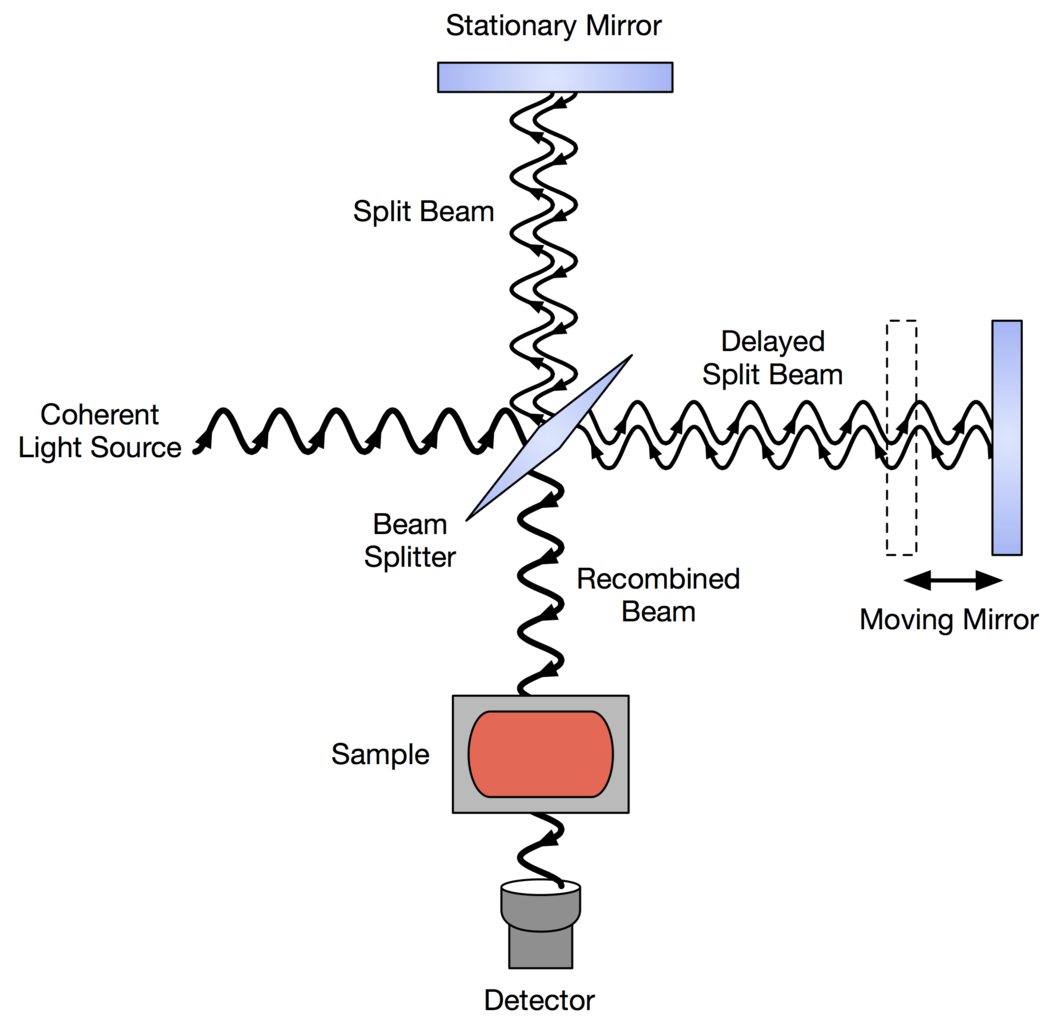
- An infrared light beam, or source, is aimed directly at an instrument called an interferometer. The interferometer uses a combination of a beam splitter, a mobile mirror, and a stationary mirror to separate the beam of light into individual wavelengths. First, the beam splitter splits the beam of infrared light at right angles into two smaller beams. One beam will hit the stationary mirror and the other will hit the mobile mirror. The angles of the mirrors allow the two separated beams to reflect, meet again, and reconstitute as one beam. The mirror mechanism separates the light into different wavelengths that are measured at the point of reconstitution. The interferometer records this information and creates a graph called an interferogram. An interferogram records information about every frequency of light from the infrared source. Most importantly, every frequency is measured at once instead of individually as earlier scientific devices required. Once the frequencies of infrared light have been measured by the interferometer, the reconstituted beam continues through the machine to the sample. The beam is applied to the sample where it will either transmit (go through) or reflect (come back towards the source). At this point, specific frequencies of energy will be absorbed by the sample and some will transmit through. The light that does transmit through the source will reach a detector on the other side. Not only does the light that reaches the detector generate information, but the absence of some wavelengths of light, the light absorbed by the sample, also generates information for analysis. The information gathered from the detector is finally sent to a computer where a chart is created specifically for that sample. This computer generated chart is called an IR spectrum.
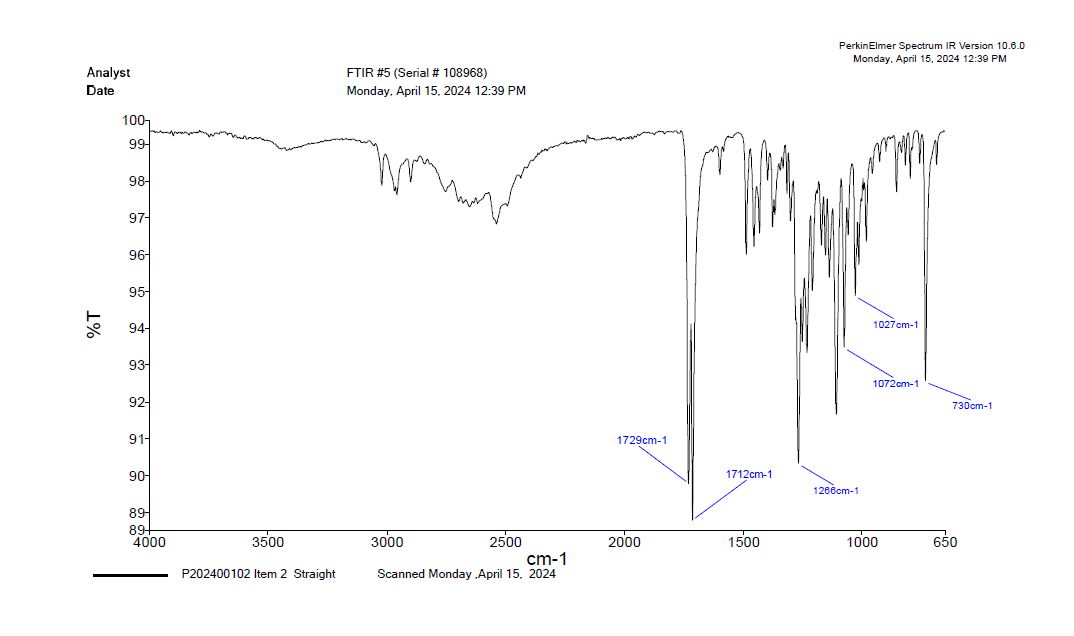
- Analysts use the IR spectrum and compare the sample’s spectrum to a known reference sample. This can be done either by computer comparison, or by an individual analyst manually comparing the two spectra. Each “peak,” explained below, is representative of a bond between two atoms. Specific well-known bonds that also have definable physical/chemical characteristics are called functional groups. Common functional groups include alcohols (- OH), ketones (=O), esters (- COOCH3), ethers (-COC-), and carboxylic acids (-COOH), to name a few. Each of these functional groups, if present, will create a distinct peak that typically is easily identifiable by a trained analyst. These peaks will be a specific intensity and be found within a specific wavelength range. When analyzing a spectra, it is important to know that the presence of a peak in a certain place does not necessarily indicate that a specific functional group or bond exists in a sample’s chemical structure. However, absence of a peak in the area where a known functional group or bond would present itself does indicate that that functional group or bond does not exist in the sample’s chemical structure. Some peaks will be more or less intense due to the bond’s nearness to other bonds (the molecule’s stereochemistry), the number of the exact same type of bonds present in a molecule (aromatic C-H bonds), and many other more complex reasons. Identification of compounds by IR spectra is an art which takes a lot of practice. Analysts must not only remember the locations of where peaks should be, but must also remember the patterns common to certain types of molecules that could be present in a larger macromolecule.
- Limitations – limitations of the analysis are based on closely related materials, mixtures, and improper preparation of the sample.
- IR cannot differentiate between isomers of the same drug.
- For an accurate spectrum, the substance must be reasonably pure (generally >90%). Testing of pharmaceuticals using IR may be more successful than the testing of street drugs which are often impure.
- Diamond cell IR, if used, allows smaller amounts of samples to be tested. If diamond cell IR is not used, then the amount of sample required for testing is much higher.
- Considerations
- Peaks from an IR spectrum are read “upside-down.” A peak, obviously poorly named, is actually observed at the lowest point on the graph, or the valley of the observed area. IR measures absorption, the opposite of transmission. Absorption and transmission are inversely related: the more a sample absorbs light, less light is actually transmitted through the sample. The more light that transmits through a sample, less light is absorbed by that sample. The y-axis of a spectra measures the percent transmission of a sample. Samples with the highest percent transmission will generate higher (deeper) peaks, and those with the lowest percent transmission will show a lower (shallower) peak or possibly no peak.
- Relative intensities of the bands are important, any significant mismatch with reference spectrum negates identification. To make an identification, an analyst considers intensity (weak, medium or strong), shape (broad or sharp), and position (cm-1) of the peaks in the spectrum. Many compounds look similar, but an exact match is necessary to confirm the identity of an unknown.
- Links
- FTIR Identification – this blog post by Dr. Fred Whitehurst discusses the limitations of the FTIR for use with forensic samples.
- Organic Chemistry Lecture – by David Van Vranken, Ph.D. of UC Irvine explaining the science behind IR Spectroscopy.
- Video on the science of FTIR
- Video of an FTIR run from start to finish.

Which Items are Tested?
When a suspected controlled substance contains many individual packages or items, crime labs decide which and how many samples to test by following a Sampling Plan. The State Crime Lab’s Sampling Procedure contains three types of sampling: Administrative, Threshold, and Hypergeometric Sample Selection.
- Administrative Sample Selection is used for pharmaceutical preparations (pills). One pill is chemically analyzed. No inferences are made about unanalyzed material.
- Considerations:
- The State Crime Lab’s procedure does not allow analysts to infer what substances may be present in the untested pills. This means there should not be testimony about the chemical composition of pills that were not chemically analyzed. The analyst may visually inspect the untested pills and compare their appearance to pictures of pills in the Micromedex database. Visual inspection is not sufficiently reliable to identify a substance. State v. Ward, 364 N.C. 133 (2010).
- It is well-known that counterfeit pills are produced in illegal/clandestine labs and are designed to look identical to prescription pills. Sometimes there are imperfections in these pills that make it possible to distinguish them from prescription pills, but when administrative sampling is used, attorneys should question how the analyst knew that the pills were pharmaceutical preparations and not counterfeit pills that should not be subjected to administrative sampling.
- Considerations:
- Threshold Sample Selection is used when it is practicable to perform individual analysis of enough units to meet a statutory threshold.
- Hypergeometric Sampling Plan is used for samples with 10 or more packages where threshold sampling is not practicable. The analyst uses statistics to determine how many items to test in order to be able to make an inference about the untested items. The analyst will state that by testing the required number of items she has demonstrated with 95% confidence that the remaining 90% of the material contains the identified controlled substance.
- Homogeneity: Each package and its contents must be visually inspected for homogeneity of size, weight, color, packaging, markings, labeling, indications of tampering and other characteristics before the samples are subjected to a sampling plan. If differences are found, hypergeometric sampling should not be used.
- Extrapolation of weight: If the analyzed portion does not meet a weight threshold, additional indiscriminately chosen samples can be weighed to meet the threshold. The lab does not require that those additional samples be tested. The lab allows analysts to extrapolate weight if it is impracticable to obtain individual weights.
- Previously used method: From 1996-2010, the crime lab and many other forensic labs determined the number of samples to be tested by using the √n+1 formula where n is the total number of samples. The analyst would make an inference about the chemical composition of the remaining samples after testing √n+1 samples. There was no scientific basis for using this method to determine how many samples to test.
Residue amounts will not be tested by the State Crime Lab unless accompanied by a written request from a prosecuting attorney.
Reports and Publications
This report by the Penn Carey Law Quattrone Center provides the first-ever comprehensive analysis of presumptive drug field test usage across law enforcement agencies in the United States. Inexpensive and fast, these tests have become a tool of choice for law enforcement agencies. Unfortunately, they are notoriously imprecise and are known to produce “false positives,” leading to frequent wrongful arrests and wrongful convictions.
- Organization of Scientific Area Committees for Forensic Evidence (OSAC) is developing documentary standards for each forensic discipline. Standards under consideration as well as approved standards are available in the OSAC Registry.
See pp. 133-136 for the National Research Counsel’s assessment of the analysis of controlled substances.
From the Blog
- Winter 2026 Cannabis Update, 1/16/2026Originally posted on the North Carolina Criminal Law blog on Jan. 14, 2026 Not much has changed for cannabis law at the state level since my last post on the topic. I noted there that several defendants were seeking review before the North Carolina Supreme Court regarding the potential impact of legal hemp and the sight or …
- Spring 2025 Cannabis Update, 3/21/2025I have been covering developments around the legalization of hemp in North Carolina since 2018. Never did I suspect then that I would still be working on the topic all this time later, but here we are. My last post on In Re: J.B.P. covered the then most recent developments around probable cause and the odor of …
- Originally posted on North Carolina Criminal Law, a UNC School of Government Blog In September, the Fourth Circuit Court of Appeals issued a significant decision affecting the hemp industry on the federal level. There has been an open question for some time regarding the legality of certain cannabinoids that do not naturally occur in the …
- Spring 2024 Cannabis Update (Part II), 4/19/2024This update was originally posted on Apr. 10, 2024 on North Carolina Criminal Law, a UNC School of Government Blog available here. In Part I of my Spring 2024 cannabis update, I discussed the search and seizure issues arising in North Carolina courts around cannabis. Part II explores drug identification evidence issues surrounding marijuana prosecutions and examines …
- Spring 2024 Cannabis Update (Part I), 4/18/2024This update was originally posted on Apr. 8, 2024 on North Carolina Criminal Law, a UNC School of Government Blog available here. It has been a while since my last post on cannabis and criminal law issues, and it is past time for an update. In addition to a number of state cases grappling with …
- Possession of Khat, 2/24/2023Originally posted on North Carolina Criminal Law – A UNC School of Government Blog Readers may have heard of the plant commonly known as khat or qat (or Catha edulis, for the botanically inclined). The plant is indigenous to Africa and is popular in parts of that continent, as well as parts of the Middle East, and is …
- State v. Booth and marijuana identification, 10/26/2022In case you missed it, the COA released State v. Booth on Oct. 18, 2022, dealing in part with lay opinions by officers identifying marijuana as such based on sight and odor only and without a proper lab test identifying the levels of delta-9 THC. The officer in Booth was permitted to testify that he could …
- Hemp remains legal in NC, 7/1/2022With Governor Cooper signing it into law yesterday Senate Bill 455 which permanently excludes hemp from the legal definition of marijuana under state law in NC, hemp’s future as a widely-available consumer product in our state seems secure. Under the new legislation, the previous requirement that the hemp be cultivated or possessed by a grower …
- Announcing Expert Services Project, 3/28/2022We want court appointed attorneys to use experts, and we want using experts to be easier for attorneys. Access to qualified expert services is essential to the provision of indigent defense. To better equip the North Carolina public defense community with the resources it needs to achieve fair and just outcomes for clients, Indigent Defense …
- There have been several posts on this and related topics here and here. This post will attempt to compile all of the resources and walk attorneys through the process of making these challenges. N.C. Gen. Stat. § 90-87(16) provides the statutory definition of marijuana, specifically excluding from its definition industrial hemp. Industrial hemp, as defined in …
Featured Articles
- The Effect of Legal Hemp on Drug Dog Sniffs, UNC School of Government
NIST article about testing of drugs that may contain fentanyl or other dangerous synthetic opioids. The article contains video clips showing how powder substances can contaminate various surfaces in laboratories and addresses ways that labs work to eliminate contamination.
Discusses the paper below and shows black-light videos that help illustrate the risk of cross contamination in a forensic drug lab.
E. Sisco, M.E. Staymates, A. Burns. An easy to implement approach for laboratories to visualize particle spread during the handling and analysis of drug evidence. Forensic Chemistry. Published online March 11, 2020. DOI: 10.1016/j.forc.2020.100232
Jan. 21, 2020 NC Criminal Law blog post by Phil Dixon with links to resources for defenders litigating the new crimes of death by distribution and aggravated death by distribution in G.S. 14-18.4 cases.
The Health In Justice Action Lab of the Northeastern University School of Law has created a toolkit for attorneys defending death by distribution of drugs. The toolkit includes recent favorable caselaw and links to the amicus curiae briefs filed by the Action Lab and its partners that were successful in those cases; an expanded section on racial disparities and person-first representation; more material and case law in several of the states that are most aggressive in pursuing DIH enforcement; a brief section on ineffective assistance of counsel claims; and information regarding forthcoming DIH research conducted by the Action Lab. Entire toolkit is available for free download. 2021 Edition.
by Joanna Gin and Edward Imwinkelreid. UC Davis Legal Studies Research Paper, available for free download. Like nuclear DNA testing, GC/MS analysis has important limitations. Courts should not assume it is a nearly infallible technique. When GC/MS is used in drug testing, the court must inquire as to the mode of analysis: full scan, selective ion reliance, or selective ion monitoring. When GC/MS is employed to identify ignitable liquids in arson investigations, the court should inquire as to the condition of the sample tested: Has it been subjected to weathering, microbial degradation, or pyrolysis?
Trainings
- Live webinar presented by Amanda Venable. Program will not be recorded. After the program, the powerpoint will be available.
- FORENSICS@NIST 2024, NISTFree to attend live multi-day webinar offered by NIST
- Free webinar offered by the Mecklenburg County Public Defender Office
- Free webinar offered by Emancipate NC
- Live webinar presented by Ed Brown, Ph.D.
- Presenters: Reta Newman and Michael Gilbert. Offered by National Clearinghouse for Science, Technology, and the Law. Recording and powerpoints are available.
- Hemp: A Forensic Perspective, FTCOEForensic Sciences at RTI International is offering a free webinar program on Mar. 31, 2020. The presentation will discuss analytical strategies to answer the question: is the material presented for analysis an illegal product based on its total THC content?
Websites
The mission of SWGDRUG is to recommend minimum standards for the forensic examination of seized drugs and to seek the international acceptance of such standards. Click here for a PDF of the current approved guidelines for Drug Analysis.
The National Forensic Science Technology Center created this website to explain in simplified terms the principles of each type of forensic analysis and how the analysis is performed. Topics include DNA, digital evidence, fingerprints, firearms, trace evidence, blood stains, and more.
This National Institute of Health searchable database allows users to search for a compound and learn more about its chemical structure, uses, properties, toxicity, and other information.
This website contains a library of GCMS data for compounds and is organized by molecular weight, base peak and second base peak. This library may be useful for limited purposes.
Books
Cases
NCSCL drug chemistry analyst Jennifer West testified about whether fentanyl was an opiate or opioid. Trial court erred in admitting West’s testimony because she lacked training on the issue of whether fentanyl was an opiate or opioid.
Evidence that cocaine was the identity of the substance was admissible not withstanding the substance being handled with bare hands and stored in a glove box where cocaine had previously been stored. The court found concerns over cross contamination went to the evidence’s weight, not matters of admissibility and authentication.
The court held that it was not plain error for the analyst to testify that GCMS testing is used to confirm results of presumptive testing but not to testify that GCMS was performed in the case at hand.
The court held that it was not plain error for the analyst to testify to the identity of a controlled substance without explaining what type of chemical analysis she performed. She testified she performed a color test and an instrumental analysis.
In August, the North Carolina Supreme Court weighed in on drug identification once again in State v. Osborne, ___ N.C. ___ (August 16, 2019). Defender Educator Phil Dixon discusses admissibility and sufficiency of evidence in drug cases in this blog post.
This document provides the relevant statutes and summarizes the case law on the issue of how marijuana should be weighed. It addresses issues such as whether water weight and mature stalks should be included. Links to the State Crime Lab’s relevant procedures are provided, as well as contact information of experts who are available to weigh suspected marijuana.
Today, the court of appeals reversed a defendant’s drug convictions because the indictments identified the controlled substances in question using terms that are widely used to describe the drugs, but that are neither the chemical names listed in the controlled substance schedules nor – according to the court – “trade names” for the drugs. Because more and more drug cases involve pharmaceuticals that have many names, it is worth reviewing the case. The case is State v. Sullivan. It arose when police used an informant to buy steroids from the defendant…
A NC Supreme Court decision finding the trial court abused its discretion by allowing the State’s expert to visually identify drugs using an insufficiently established method. The court found the expert’s use of information in Micromedex literature to make drug identification did not meet the first prong of Rule 702 as it was never established as reliable before the trial court. The court indicated that chemical analysis might be required within the bounds of “common sense.”
A California Attorneys for Criminal Justice (CACJ) report by John Kelly. The report is largely based on the research of Dr. Frederic Whitehurst who tested field drug test kits and exposed and documented that they render false positives with legal substances. The report focuses on the Duquenois-Levine and KN Reagent tests used to test for marijuana.
Motions and Briefs
Sample discovery motion regarding drug chemistry or toxicology evidence.
Drug Analysis in the News
- NIST Study Shows How the Toxic Substances Mixed Into Fentanyl Vary Across the U.S. and Change Over Time, NIST, 10/8/2026
- What’s in My Weed?, by Jeffrey Billman, The Assembly, 6/26/2026
- Colorado becomes first state to ban arrests solely based on field drug test results, by Marissa Ventrelli, The Denver Gazette, 4/13/2026
- Colorado Becomes First State To Protect Defendants Against Faulty Roadside Drug Tests , by C.J. Ciaramella, Reason, 4/3/2026
- The $2 drug test sending nearly 30,000 innocent Americans to jail, Washington Post, 3/31/2026
- How the Internet Became the “Cookbook” of the Drug Trade, New York Times, 3/31/2026
- He Was Arrested Over Bogus Drug Tests. Now He’s Suing., by C.J. Ciaramella, Reason, 3/11/2026
- North Carolina hemp users face challenges as federal ban is set to limit THC products, by Flynn Snyder, WRAL, 11/15/2025
Drug Analysis Experts
- Edward G. Brown, Ph.D., Durham, NC
- Guy Oldaker, Ph.D., Lewisville, NC
- Rohan U. Parekh, MS, PhD, Durham, NC
- Bethany P. Pridgen, MFS, Wilmington, NC
- Dr. Frederic Whitehurst, Bethel, NC
Additional Info
Forensic Chemist with more than 13 years of analytical and supervisory forensic laboratory experience. Available for case consultation and testimony regarding forensic alcohol analysis, retrograde extrapolation, and controlled substances weighing and testing procedures. Available to review lab documents including SOPs, QC data, and QA documents for compliance with SOPs and provide testimony to findings. Has experience with ISO 17025:2005 and ISO 17025:2017 quality management program with Lead Assessor and Technical Assessor certificates.