
Study Examines Fairness of Court Hearings for Autistic IndividualsRead More
Mental Health
The Diminished Capacity Defense in Capital Cases
PowerPoint and manuscript prepared by Vince Rabil, updated 2026.
Webinar: Reading School Records
Live webinar presented by Heather CoxAug 6, 2026, 12:30pm90 min of CLE credit anticipated School records often contain valuable information that can help explain a client’s behavior, development, educational needs, and life circumstances—but only if attorneys know where to look. As part of our neurodiversity webinar series, this program will provide criminal defense attorneys with …
Reading School Records
Live webinar presented by Heather CoxAug 6, 2026, 12:30pm90 min of CLE credit anticipated School records often contain valuable information that can help explain a client’s behavior, development, educational needs, and life circumstances—but only if attorneys know where to look. As part of our neurodiversity webinar series, this program will provide criminal defense attorneys with …
A scientist says he can scan prisoners’ brains for signs of evil. Did his disputed science put a man on death row?
Webinar: Reading Medical Records
Live webinar presented by Raj V. Patel, MD, FACEP, FAAEMJuly 9, 2026, 12:30pm90 min of CLE credit anticipated Medical records can contain critical information for understanding a client’s history, functioning, diagnoses, trauma exposure, and support needs—but many attorneys receive thousands of pages of records with little guidance on how to interpret them. In this webinar, …
Reading Medical Records
Live webinar presented by Raj V. Patel, MD, FACEP, FAAEMJuly 9, 2026, 12:30pm90 min of CLE credit anticipated Medical records can contain critical information for understanding a client’s history, functioning, diagnoses, trauma exposure, and support needs—but many attorneys receive thousands of pages of records with little guidance on how to interpret them. In this webinar, …
Understanding ADHD and Its Impact in Criminal Cases
Live webinar presented by Dr. Beata KrembuszewskiApr. 2, 2026, 12:30pm90 min of CLE credit anticipated This session will present a clear, research-based understanding of Attention-Deficit/Hyperactivity Disorder (ADHD) and its relevance across the lifespan of many clients in the criminal legal system. The session explores the core diagnostic features of ADHD—impulsivity, inattention, executive-function deficits, emotional regulation …
Understanding ADHD and Its Impact in Criminal CasesRead More
Understanding ADHD and Its Impact in Criminal Cases
Free live webinar offered by NCIDS
Understanding ADHD and Its Impact in Criminal CasesRead More
Webinar: Neurodivergence in Criminal Justice, Forensic Mental Health, and Legal Settings
Live webinar presented by Dr. Jerrod BrownFeb. 5, 2026, 12:30pm90 min of CLE credit Neurodivergence describes a group of individuals with atypical patterns of brain functioning, including differences in cognition, sensory, and motor abilities. Conditions such as attention deficit/hyperactivity disorder, autism, fetal alcohol spectrum disorder, learning difficulties (e.g., dyslexia), and traumatic brain injuries often fall …
Webinar: Neurodivergence in Criminal Justice, Forensic Mental Health, and Legal SettingsRead More
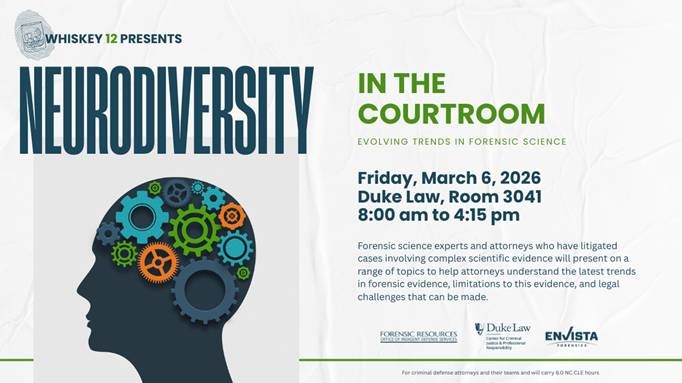
Whiskey in the Courtroom: Evolving Trends in Forensic Science – REGISTRATION OPEN
Indigent Defense Services and the Duke Law Center for Criminal Justice and Professional Responsibility are pleased to announce the twelfth annual CLE, “Whiskey in the Courtroom: Evolving Trends in Forensic Science.” Whiskey 12 will take place on March 6, 2026 at Duke Law School. Forensic science experts and attorneys who have litigated cases involving complex scientific …
Whiskey in the Courtroom: Evolving Trends in Forensic Science – REGISTRATION OPENRead More
Whiskey in the Courtroom: Evolving Trends in Forensic Science – REGISTRATION OPEN
Indigent Defense Services and the Duke Law Center for Criminal Justice and Professional Responsibility are pleased to announce the twelfth annual CLE, “Whiskey in the Courtroom: Evolving Trends in Forensic Science.” Whiskey 12 will take place on March 6, 2026 at Duke Law School. Forensic science experts and attorneys who have litigated cases involving complex scientific …
Whiskey in the Courtroom: Evolving Trends in Forensic Science – REGISTRATION OPENRead More
The Diminished Capacity Defense in Capital Litigation: A Summary Explanation (2025)
Paper by retired Assistant Capital Defender Vince Rabil. Available upon request. Email sarah.r.olson@nccourts.org
The Diminished Capacity Defense in Capital Litigation: A Summary Explanation (2025)Read More
Mental Health Defenses—Diminished Capacity and Voluntary Intoxication: What Can the Expert Say?
2026 IDS Forensic Science Education Series
IDS and the Mecklenburg Public Defender’s Office provide regular continuing education to dozens of NC criminal defense and parent attorneys, investigators, and mitigation specialists who attend the IDS Forensic Science Education Series. In 2026, we will offer monthly 90-minute webinars on various aspects of forensic evidence. These webinars will take place typically at 12:30 pm on …