
PowerPoint and manuscript prepared by Vince Rabil, updated 2026.
Featured Articles
Challenges with Touch DNA: Implications for Interpreting and Evaluating Touch DNA Evidence
Researchers aiming to understand how long touch DNA remains detectable on different surfaces under various environmental conditions conducted a study funded by the National Institute of Justice (NIJ). The research highlights the challenges associated with low and variable quantities of touch DNA collected, making it difficult to accurately assess DNA degradation. However, the findings provide …
Challenges with Touch DNA: Implications for Interpreting and Evaluating Touch DNA EvidenceRead More
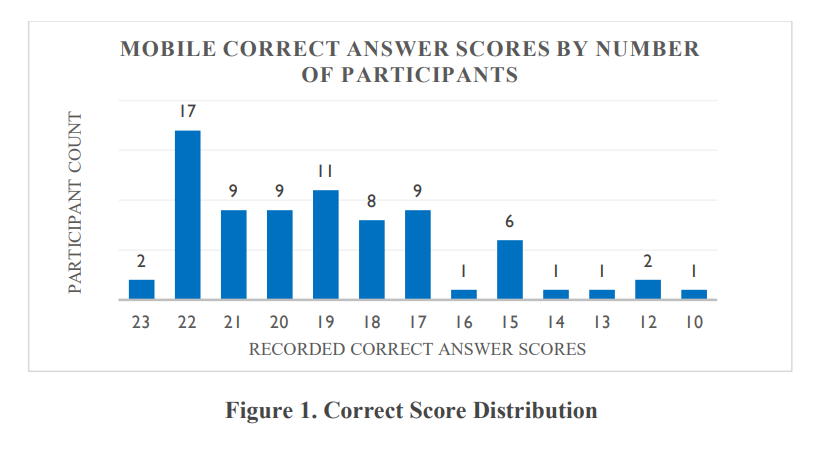
Results from a Black-Box Study for Digital Forensic Examiners
In Feb. 2022, NIST published the results of a study that looked at outcomes of mock mobile and hard-drive examinations by digital forensic examiners. 394 individuals registered for the mobile test, and 77 participants completed the mobile case study. 450 individuals registered for the hard-drive test and 102 participants completed the hard drive case study. …
Results from a Black-Box Study for Digital Forensic ExaminersRead More
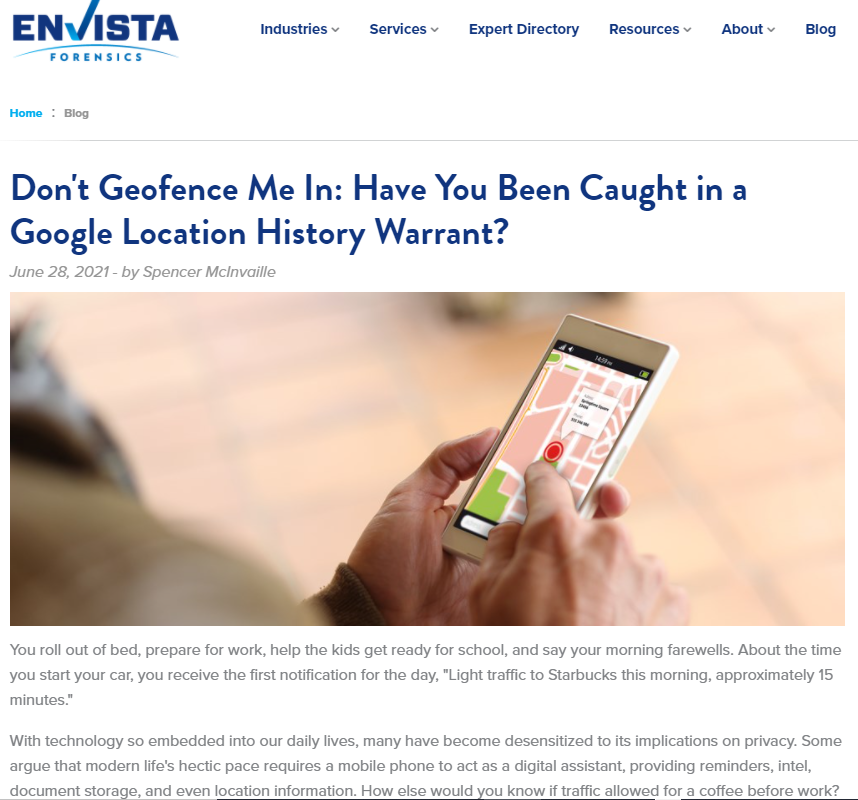
Don’t Geofence Me In: Have You Been Caught in a Google Location History Warrant?
Spencer McInvaille has posted about geofence warrants on the Envista Forensics blog. These warrants have been used in several NC cases. If you’re handling a case involving a Google location history warrant, be sure to check out Spencer’s post to understand how these searches work and the constitutional implications of this type of search. Click …
Don’t Geofence Me In: Have You Been Caught in a Google Location History Warrant?Read More
The effect of contextual information on decision-making in forensic toxicology
This recent study by Dr. Hilary J. Hamnett and Dr. Itiel E. Dror looked into the possible effects of contextual case information in forensic toxicology testing. Two experiments were conducted in this study. The first focused on the interpretation of immunoassay screening data and the error rates of the participants’ conclusions. The participants were asked …
The effect of contextual information on decision-making in forensic toxicologyRead More
Field Sobriety Tests and THC Levels Unreliable Indicators of Marijuana Intoxication
National Institute of Justice-supported researchers from RTI International recently published the results of their research showing that field sobriety tests and THC levels are unreliable indicators of marijuana intoxication. The full study can be read here. A summary of the research is available here and provided the following take-aways that will be of interest for …
Field Sobriety Tests and THC Levels Unreliable Indicators of Marijuana IntoxicationRead More
Investigative Reporting Sheds Light on How Extensively Government Agencies Nationwide Have Used Facial Recognition Software – Searchable Database Available
On April 6th, Buzzfeed News published its findings on an investigation that probed how extensively government agencies had used the controversial facial recognition software, Clearview AI, in their daily operations. However, many of the agencies listed in the report state that they do not use Clearview AI. Buzzfeed News has created a searchable table that …
Behavioral Science Briefs for the Trial Advocate
The latest volume of Behavioral Science Briefs for the Trial Advocate was published recently and is available here. It summarizes research on issues including juror decision-making, mock jurors’ evaluation of firearm testimony, eyewitness identifications, child interviewing, and other topics relevant to the criminal practitioner. A deep understanding of human behavior offers an edge to trial attorneys. …
Fingerprint Error Rate on Close Non-Matches
Research by Jonathan J. Koehler and Siquan Liu on the accuracy of distinguishing between two close non-matches was published in Sept. 2020. Attorneys should be aware of the error rates presented in this paper, particularly when working on cases involving a match to a suspect developed by searching a fingerprint database. As fingerprint databases grow, …
Newly-Developed Drug Test May Be Able to Help Distinguish Hemp from Marijuana
In July of 2019, Virginia became the first US state to acquire a new drug test created by a team of forensic chemists in Switzerland. The 4-AP test, or “Cannabis Typification” or “Swiss Test,” purports to be able to help differentiate between hemp– a legal variety of cannabis– and marijuana. However, laboratory documentation says that …
Newly-Developed Drug Test May Be Able to Help Distinguish Hemp from MarijuanaRead More
“Too Pandora’s Boxy for Silicon Valley” – John Oliver Discusses the Use of Facial Recognition Technology by Law Enforcement
This past Sunday, on his weekly half-hour HBO show, Last Week Tonight, comedian John Oliver discussed the growing prevalence of facial recognition technology in the criminal justice system. The issue is particularly relevant as protestors in the recent demonstrations demanding justice for George Floyd (and the numerous other BIPOC who have been subjected to violence …
The Blind Leading the Blind: Recent Article Discusses the HFSC Blind Testing Program
From the National Academy of Sciences, to the Washington Post, to Last Week Tonight With John Oliver, there seems to be consensus that additional research is needed to validate several fields of forensic science. One challenge in collecting sufficient evidence to establish foundational validity is that because there is no ground truth in forensic casework, …
The Blind Leading the Blind: Recent Article Discusses the HFSC Blind Testing ProgramRead More
Probabilistic genotyping software for interpreting DNA mixtures
NC attorneys may be aware that software programs are being adopted by crime laboratories to assist with interpreting complex DNA mixtures. The NC State Crime Laboratory is working on validating a procedure for the use of STRmix probabilistic genotyping software, which will likely go online in the coming months.
Probabilistic genotyping software for interpreting DNA mixturesRead More
DNA Mixtures: A Forensic Science Explainer
NIST has created a primer on interpretation of DNA mixtures that explains what are DNA mixtures and why are they sometimes so difficult to interpret.
Can law enforcement compel a subject to unlock a device?
The NACDL Fourth Amendment Center has authored a Compelled Decryption Primer to help attorneys litigate the issue of whether law enforcement can compel a suspect to unlock or decrypt a device. The Fourth Amendment requires law enforcement to get a warrant to search a cell phone, even incident to arrest. Riley v. California, 573 U.S. …
Can law enforcement compel a subject to unlock a device?Read More