
Toxicology is the study of the effects of drugs on biological systems. Specifically, forensic toxicology focuses on the detection of alcohol, drugs, and other toxic substances in the human body. The State Crime Laboratory currently uses screening and confirmatory tests to indicate the presence of a drug in a defendant’s blood or occasionally urine. For information about testing an item of evidence to see if it is a controlled substance, click here. For information about defending Death by Distribution cases, click here. Methods for toxicology analysis are regularly updated, so always check that you have the most up-to-date version of the testing lab’s procedures.
Procedures for Testing Bodily Fluids for Drugs
Toxicology samples that are being tested for drugs are screened using a presumptive test, such as the ELISA test. If the screening yields a positive result, the sample must undergo an extraction and be tested using a confirmatory test to conclusively identify the substance that is present and potentially quantify the amount of the substance that is present.
- Presumptive Test
- ELISA Immunoassay
- Identification and Quantification
- Extraction
- Identification and Quantitation
- Characteristics:
- ELISA can be performed on blood and urine.
- Immunoassays measure the presence or concentration of a substance in urine or other fluid by using antibodies that specifically bind to drugs and their metabolites (the compounds that form after the body has metabolized a drug).
- How it works:
- An antigen is a foreign substance that induces an immune response by triggering the production of an antibody.
- In immunoassays, antibodies that contain enzymes react and bind to a drug or drug metabolite. This reaction generally produces a signal, such as a color change, or can be measured using other methods of measuring enzyme activity.
- Substances it tests for:
- Results:
- Understanding how the laboratory reports results is imperative. The State Crime Laboratory reports results stating that a specific drug or classes of drugs are positive or negative. These results must be confirmed by a confirmatory test.
- ELISA immunoassays measure the color change that occurs when a sample tests positive for a specific drug. The State Crime Laboratory uses the Tecan/Immunalysis Freedom EVO ELISA Analyzer to measure the color change. This machine measures the color change by determining how much light is absorbed by the sample, also known as the absorbance.
- Absorbance and concentration are inversely related. If a sample’s absorbance is low, the concentration of the drug present in the sample is higher. If a sample’s absorbance is high, the concentration of the drug present in the sample is lower. This chart demonstrates how results are reported:
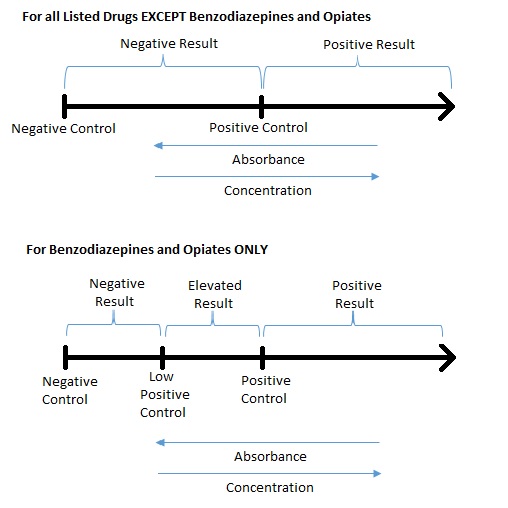
- All results that test positive or elevated will continue to confirmation testing, including extraction and either GC/MS or LC-MS/MS analysis.
- Limitations:
- Because immunoassays are only screening tests, positive results must be confirmed using a confirmatory test.
- False positives with are possible. A list of cross-reactivities is available here.
- Links:
- This video demonstrates how an ELISA test is performed and how the science works.
Blood and urine contain a wide variety of compounds. Confirmatory tests (GC/MS, LC-MS/MS) cannot be performed on whole blood or urine samples since there are too many compounds. Some compounds may interfere with the machine’s ability to interpret the presence of a substance of interest. To solve this problem, prior to confirmatory analysis, the analyst must perform an extraction to isolate the testable portion of the sample. An extraction is scientific technique that separates immiscible compounds (ones that do not mix easily) based on their solubilities. The State Crime Laboratory uses both liquid-liquid extraction and solid phase extraction in their procedures. Those procedures are described below:
- Acidic/Neutral Drug Solid Phase Extraction (ANSPE)
- This procedure is to be used for extraction of acidic, neutral, and basic drugs from blood, serum, and urine.
- It should not be used for cannabinoids or phenethylamines.
- The sample will be separated into acidic/neutral and basic fractions via an extraction column.
- Typically, the acidic/neutral fraction will contain barbiturates, carisoprodol, meprobamate, and some benzodiazepines. Alkaloids, amphetamines, opiates, zolpidem, tramadol, and most benzodiazepines elute in the basic fraction.
- Some compounds may need to be further separated by derivatization. The technique of derivatization does not change the drug being tested, it only removes the insignificant ions that interfere with GC testing.
- Morphine and benzoylecgonine are examples of drugs that need to be derivatized for detection. Some benzodiazepines will need to be derivatized if they already screened as positive or elevated in a sample and no corresponding signal was detected in subsequent GC/MS testing.
- Phenethylamine Liquid-Liquid Extraction (PHEALLE) for Analysis by GC-MS – This procedure is to be used to extract phenethylamine drugs (such as methamphetamine, MDMA, amphetamine, ephedrine, or pseudoephedrine) from blood or urine.
- Blood Cannabinoid Liquid-Liquid Extraction (BCLLE) for Analysis by LC-MS/MS – This procedure is to be used for extraction of cannabinoids from a blood sample. This procedure is not to be performed on urine samples. This test is used to test for presence of THC, THCA, and 11-OH-THC.
Once the desired portion of the sample is isolated it is then conclusively identified and if appropriate, quantitated. The State Crime Laboratory tests blood, urine, and serum using two methods: Gas Chromatography/Mass Spectrometry (GC/MS) and Liquid Chromatography Tandem Mass Spectrometry (LC-MS/MS).
- Gas Chromatography/Mass Spectrometry (GC/MS)
- This technique is used after an extraction performed using the PHEALLE (liquid-liquid extraction) method or solid phase extraction method.
- For more information about the science behind GC/MS, how a GC/MS works, and the limitations/considerations of GC/MS testing, click here to be redirected to the NCIDS Drug Analysis page.
- Toxicology-specific limitations/considerations of GC/MS testing:
- Subtraction: The State Crime Laboratory’s procedure for Toxicology GC/MS testing allows for the analyst to subtract interfering signals from the chromatogram. The procedure proscribes that when additional major ions are present, the source of the extraneous, background ions may be subtracted prior to formal analysis (peaks may be removed from the chromatogram to better visualize the remaining peaks, which are then compared to known reference standards). Only a trained expert will be able recognize if and when an essential peak has been erroneously subtracted and should be consulted as needed.
- The State Crime Laboratory Procedure lists its criteria for a positive match for GC/MS data. These criteria include:
- The mass spectrum shall be compared to reference mass spectra.
- Probability Based Matching (PBM) is a computer-calculated figure that represents the probability that the peak of interest matches the reference peak. Ex. Unknown peak has 98% probability of matching cocaine. PBM shall be used to aid in identification but should not be used as the sole means of identification.
- The mass spectrum must contain all of the major and diagnostic ions unique to the analyte.
- The signal to noise ratio (the response at the baseline or valley immediately before the internal standard signal) of the internal standard must be greater than 5:1.
- To be considered a match, the ion’s retention time must be within 2% of the reference standard’s retention time.
- This method is not to be used to distinguish between optical isomers.
- Liquid Chromatography Tandem Mass Spectrometry (LC-MS/MS)
- This technique is used only in conjunction with the BCLLE extraction method, for blood cannabinoid testing.
- How it works:
- Liquid Chromatography (LC) is similar to Gas Chromatography (GC), except that the mobile phase used to separate molecules is a liquid instead of a gas. Molecules are separated by a liquid mobile phase so that they can be analyzed after separation by a mass spectrometer.
- Tandem Mass Spectrometry/Mass Spectrometry (MS/MS) is the technique used here to further separate the molecules into measurable fragments. When a molecule travels through the mass spectrometer, and breaks apart, the resulting pieces are called fragments. The fragments are measured by the detector at the end of the mass spectrometer which creates peaks on a mass spectrum. A higher volume (number) of a specific fragment will generate a higher peak on a mass spectrum. The size and position of the peaks on a mass spectrum will exclusively identify unknown compounds. Tandem mass spectrometers have more than one analyzer that operate simultaneously and further separate complex molecules into more defined fragments. See the Drug Analysis page for additional explanation of the science of mass spectrometry. Tandem MS/MS analysis is specifically used for determining the structure of a molecule, while MS alone is used to determine the molecular weight of the molecule. Tandem mass spectrometry can be used to distinguish between molecules that are very similar.
- Limitations:
- This procedure shall not be used to distinguish between optical isomers.
- All body fluids must be homogeneous (same throughout). The blood/urine/serum must be well-mixed prior to sampling (taking an aliquot) so that what is taken from the sample is representative of the entire sample. If a homogeneous sample cannot be obtained, the procedure requires that this be noted in the report.
- The internal standard must be within 50% to 200% of the average internal standard range.
- Typically, if a batch fails, the analyst will repeat testing on a new aliquot. If not enough sample remains, the failed batch data may still be reported if certain criteria are met.
Procedures for Testing Blood for Alcohol
The Toxicology Section at the State Crime Laboratory performs Headspace Gas Chromatography to both confirm the presence of alcohol and quantitate the amount of alcohol present in a blood sample.
- Characteristics:
- GC Headspace is not an altogether different method of toxicology analysis, but simply just a different way of introducing the sample into the machine.
- Volatile liquids (such as alcohol) are favorable types of samples to be tested with GC Headspace.
- How it works:
- The analyst will fill a GC vial with a proscribed amount of the Internal Standard Solution and the blood sample and seal the vial with a cap.
- The Internal Standard Solution contains ethanol, methanol, isopropanol, and acetone. It is added so that the analyst can later compare the peaks produced by the known amounts of these standards with the peaks produced by the evidence sample.
- The volatile analytes (ethanol, methanol, isopropanol, and acetone) will begin to vaporize inside the vial (similar to a carbonated drink building up pressure in a sealed bottle.)
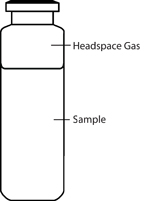
- The vial will contain a layer of blood at the bottom and a layer of gas on the top called the headspace. After time, headspace will have equilibrated (the contents of the gaseous layer will be equally distributed throughout that layer) and the headspace can be tested by the machine.
- The machine will draw a sample for testing from the headspace. The headspace gas sample will continue through the gas chromatograph as described in the gas chromatography section of the NCIDS Drug Analysis webpage. See this video for additional explanation of headspace sampling.
- After the headspace sample is separated into its component parts by the gas chromatograph, the components will enter the Flame Ionization Detector (FID) which measures the amount of analyte present. A hydrogen flame will cause the organic compounds in each component to combust. The strength of the combustion is proportional to the amount of the organic compound present and is measured by the height of the flame. The height of the flame will be represented as a peak on the resulting graph.
- Identification of ethanol is determined by comparison of its retention time with the retention time of a known standard in the Internal Standard Solution.
- Limitations:
- GC Headspace primarily tests for the presence of alcohols (ethanol, methanol, and isopropanol) and acetone. For quantitation purposes, a calibration curve must be made for each analyte.
- The blood is sampled and tested four times (in replicate). Each run will have a resulting concentration of all four analytes. Therefore, there will be a total of 4 resulting concentrations for each analyte. The four concentrations are averaged and reported as a mean. If any of the requirements below are not met, then the sample must be reanalyzed:
- Each of the four concentrations for ethanol must be within 5% of the mean.
- Each of the four concentrations for methanol, isopropanol, and acetone must be within 10% of the mean.
- No further analysis is performed on DWI submissions where the BAC was found to be 0.08 g/100 mL of whole blood unless:
- The case involves the death or personal injury of someone other than the driver of the vehicle.
- Upon approval of a request from the District Attorney’s office.
- Homogeneous samples are required for analysis. If a homogeneous sample cannot be obtained due to clots, blood cells becoming separated from the liquid, or other reason, the concentration must be converted to whole blood alcohol concentration by dividing the alcohol concentration by 1.18 to compensate for the water present in the sample.
Reports and Publications
- Organization of Scientific Area Committees for Forensic Evidence (OSAC) is developing documentary standards for each forensic discipline. Standards under consideration as well as approved standards are available in the OSAC Registry.
The AAFS Standards Board develops documentary standards for forensics through a consensus process, involving participation by all directly and materially affected persons. Standards are being developed for each forensic discipline.
Department of Justice article regarding issues raised by drug court programs regarding drug testing.
The Washington State Patrol has posted the following manuals online: DWI Detection and Standardized Field Sobriety Testing, DRE, and Advanced Roadside Impaired Driving Enforcement (ARIDE). These manuals are available for download.
This National District Attorney Association has these and other guides for prosecutors available on their website:
- Cross-Examination for Prosecutors
- The Drug Evaluation and Classification (DEC) Program
- Drug Toxicology for Prosecutors
- Hardcore Drunk Driving Prosecutorial Guide: A Resource Outlining Prosecutorial Challenges, Effective Strategies and Model Programs
- Horizontal Gaze Nystagmus—The Science and the Law: A Resource Guide for Judges, Prosecutors and Law Enforcement
- Overcoming Impaired Driving Defenses
July 2017 NHTSA report – The report describes the absorption, distribution and elimination of delta-9-tetrahydrocannabinal (THC) the primary psychoactive substance in marijuana, in the body. It contrasts this process with the absorption, distribution and elimination of alcohol in the body, as they are very different processes. The poor correlation of THC concentrations in the blood with impairment is discussed, along with the implication that setting per se levels is not meaningful. Some of the challenges of measuring driving impairment resulting from marijuana use are reviewed. State laws relating to marijuana and driving are presented. What is known about the prevalence of marijuana-impaired driving and the crash risk associated with marijuana-impaired driving is reviewed.
Finally, the report presents information on training for law enforcement to detect marijuana impairment in drivers, the feasibility of developing an impairment standard for driving under the influence of marijuana and recommendations for increasing data collection regarding the prevalence and effects of marijuana-impaired driving.
This 2014 article lists the therapeutic, toxic, and fatal blood drug concentration levels for many controlled and non-controlled substances.
The National Highway Traffic Safety Administration offers information about the effects of impairing substances.
Reference cited by the NC State Crime Laboratory. Provides the normal, therapeutic, toxic, and lethal blood level for various drugs and their metabolites.
From the Blog
- Access to qualified expert services is essential to public defense. To better equip defenders with the resources they need to achieve fair and just outcomes for clients, Indigent Defense Services launched the pilot Expert Services Project in 2021 and is expanding it to include toxicology and pharmacology experts on July 1, 2025. This Project provides …
- In April 2025, The Guardian reported that Quest Diagnostics used an “alternative reagent” in thousands of urine drug screens conducted within California prisons (https://www.theguardian.com/us-news/2025/apr/09/california-prison-drug-tests). This change, made without sufficient external disclosure, resulted in a dramatic spike in presumptive positive tests for opiates—tripling the usual rate. More than 5,000 incarcerated individuals may have been affected, many …
- Changes to Remote Testimony by Lab Analysts, 12/10/2021Defenders should make sure they are familiar with how recent legislative changes affect remote testimony by lab analysts, especially in district court. Shea Denning’s post on the School of Government Blog provides an in-depth analysis of the changes. The AOC provided a memo on the issue, available here. The AOC has also created the AOC-CR-346 …
- Marijuana Impairment FAQ, 11/9/2021Overview: Blood concentrations of THC and its metabolites are not sufficient to prove impairment. Testimony about additional signs of impairment is necessary to prove impairment. The main reasons for the disconnect between THC blood concentration and impairment is that impairment occurs in the brain, not the blood, and the chemical nature of THC causes it …
- THCA: One Abbreviation, Two Compounds, 10/13/2021Have you received a lab report in a DWI case where blood is tested by the State Crime Lab for cannabinoids? If so, the report probably had a section that looked like this: When forensic labs test blood for marijuana, they test for the presence of delta-9-tetrahydrocannabinol (THC), which is the primary psychoactive component of …
- This recent study by Dr. Hilary J. Hamnett and Dr. Itiel E. Dror looked into the possible effects of contextual case information in forensic toxicology testing. Two experiments were conducted in this study. The first focused on the interpretation of immunoassay screening data and the error rates of the participants’ conclusions. The participants were asked …
- National Institute of Justice-supported researchers from RTI International recently published the results of their research showing that field sobriety tests and THC levels are unreliable indicators of marijuana intoxication. The full study can be read here. A summary of the research is available here and provided the following take-aways that will be of interest for …
- An announcement from Becton Dickinson and Company (BD) may raise doubts about the validity of some blood alcohol tests conducted across the country since August 31, 2018. On May 30, 2019, with a correction made June 12, 2019, BD announced a recall for its “BD Vacutainer® Fluoride Tubes for Blood Alcohol Determinations” product. Vacutainers are …
- The American Academy of Forensic Science Standards Board (ASB) has published ANSI/ASB Best Practice Recommendation 037, Guidelines for Opinions and Testimony in Forensic Toxicology, First Edition. This document delineates guidelines for best practices in forensic toxicology opinions and testimony, including human performance toxicology (e.g., driving under the influence of alcohol or drugs), postmortem forensic toxicology, …
- OCME Toxicology Lab Procedures available, 9/18/2018The IDS Forensic website has posted the toxicology lab procedures from the NC Office of the Chief Medical Examiner here. Attorneys who would like to learn more about the procedures that the OCME toxicology lab uses to test evidence can read through the procedures. For casework, attorneys should obtain the lab procedures that were in …
Featured Articles
- Errors in toxicology testing and the need for full discovery, Forensic Science International2025 Forensic Science International article available for full text download
- Medical Cannabis and Driving, Royal Australian College of General PractitionersThomas R Arkell, Danielle McCartney, and Iain S McGregor article
This study investigates the effects of contextual information on forensic toxicology testing and analysis. By Hilary J. Hamlett & Itiel E. Dror
Researchers investigated how marijuana affects skills required for safe driving and found that biofluid levels of THC did not correlate with field sobriety test performance or marijuana intoxication, regardless of how the cannabis was ingested.
Jan. 27, 2020 North Carolina Criminal Law blog post by Shea Denning
Jan. 21, 2020 NC Criminal Law blog post by Phil Dixon with links to resources for defenders litigating the new crimes of death by distribution and aggravated death by distribution in G.S. 14-18.4 cases.
The Health In Justice Action Lab of the Northeastern University School of Law has created a toolkit for attorneys defending death by distribution of drugs. The toolkit includes recent favorable caselaw and links to the amicus curiae briefs filed by the Action Lab and its partners that were successful in those cases; an expanded section on racial disparities and person-first representation; more material and case law in several of the states that are most aggressive in pursuing DIH enforcement; a brief section on ineffective assistance of counsel claims; and information regarding forthcoming DIH research conducted by the Action Lab. Entire toolkit is available for free download. 2021 Edition.
by Joanna Gin and Edward Imwinkelreid. UC Davis Legal Studies Research Paper, available for free download. Like nuclear DNA testing, GC/MS analysis has important limitations. Courts should not assume it is a nearly infallible technique. When GC/MS is used in drug testing, the court must inquire as to the mode of analysis: full scan, selective ion reliance, or selective ion monitoring. When GC/MS is employed to identify ignitable liquids in arson investigations, the court should inquire as to the condition of the sample tested: Has it been subjected to weathering, microbial degradation, or pyrolysis?
Article from US Pharmacist that addresses potential false-positives and false-negatives in urine screens.
Explains possible cross-reactivities/false positives in urine drug screens. Full article available for download.
Trainings
Live webinar presented by Barbara Bathke, JD and Ivana Brown, JD
Oct. 1, 2026, 12:30pm
90 min of CLE credit anticipatedForensic evidence can be the centerpiece of a DWI prosecution—but understanding what the laboratory results actually mean is critical to effectively challenging that evidence. This practical primer will introduce defense attorneys to the forensic science commonly encountered in DWI cases, including breath testing, blood testing, alcohol and drug toxicology.
This session will focus on what the results mean and questions attorneys should ask when reviewing forensic reports. Attendees will leave with practical tools for identifying weaknesses in forensic evidence, developing cross-examination questions, and determining when consultation with a forensic expert may strengthen the defense.
Registration:
This program is part of the 2026 IDS Forensic Science Education Series. The webinars will be presented monthly and are free to attend. Use this link to register for all webinars in the series and attend any that are of interest.Presenters:
Barbara Bathke is an Assistant Public Defender at the Mecklenburg County Public Defender’s Office. She handles DWIs and various other misdemeanors and felonies. Barbara received her Bachelor of Arts degree in Business Management and History at the American University of Paris. She then attended Tulane University Law School, where she served as the Assistant Director of Tulane’s Immigration Legal Assistance program and as a student attorney in Criminal Justice Clinic and Women’s Prison Project. In her clinical work, Barbara represented criminalized survivors of intimate partner violence in post-conviction proceedings using testimony from experts in psychology. In her role at the Mecklenburg County Public Defender’s Office, Barbara continues to challenge expert testimony presented by the state, including breath and blood tests in DWI cases, fingerprint identification, and trademark analysis. Through the IDS Expert Services Project, she has also called experts in the fields of pharmacology and toxicology to testify to the effects of medical conditions on the performance of standardized field sobriety tests and breath tests as well as experts in psychology to testify regarding confirmation bias and issues of cross racial identification.Ivana Hughes Brown is an Assistant Public Defender at the Mecklenburg County Public Defender’s Office. She handles DWIs and various other misdemeanors. Prior to her current role, she served as the office’s Driving While Impaired (DWI) defense attorney at the Public Defender’s Office in Cleveland County, NC. She has the following training directly related to DWI/DUI Defense: NHTSA DWI Detection and SFSTs; Advanced Roadside Impaired Driving Enforcement (ARIDE); and NHTSA DWI Detection and Standardized Field Sobriety Test Instructor. Ivana has been practicing law in various capacities for almost 10 years. Prior to joining the public defender’s office she worked in private practices where she handled family law, civil litigation, DWI defense, and other criminal defense cases. Ivana received her Bachelor of Arts degree in Political Science with a minor in English from Gardner-Webb University. While at Gardner-Webb, Ivana was a member of the track and field and cross-country teams. After college, Ivana attended law school at the University of Alabama where she graduated with pro bono honors. Ivana is licensed to practice in both North Carolina and Georgia. Ivana currently practices solely in North Carolina.
Free to attend webinar series offered by Center for Forensic Science Research and Education
Drug-impaired driving continues to challenge law enforcement as the drug landscape becomes increasingly complex. Unlike alcohol impairment, the effects of drugs, and particularly combinations of drugs, can vary considerably, making roadside detection and investigation more difficult. Evolving patterns of drug use and emerging substances require access to training designed to address these topics with the most updated information.
In this new webinar series, CFSRE will implement a year-long education initiative designed to provide law enforcement officers and Drug Recognition Experts with timely, science-based training grounded in current research. The series will begin with “Trust the Signs? Connecting DRE Evaluations with Toxicology,” a webinar highlighting findings from prior research that paired Drug Recognition Expert evaluations with laboratory-confirmed toxicology results.
Participants will examine how frequently key physiological, behavioral, and psychophysical indicators occur across single-drug and polysubstance cases and explore how those findings compare with expectations outlined in the DRE drug influence evaluation matrix. The remaining three webinars will focus on emerging drugs, evolving impairment trends, and topics identified by officers as areas where additional education would enhance field investigations. Participants will gain a practical understanding of the pharmacology associated with commonly encountered and emerging substances, how those substances are expected to present during DRE evaluations, and how toxicology testing can support investigative observations.
The webinar series will bring together different perspectives and will provide officers with current, evidence-based information they can immediately apply in the field, strengthening impaired driving enforcement.
- Offered by NACDL, no registration cost.
- Free webinar offered by NACDL. Open to non-NACDL members.
- Free 10-part webinar series on toxicology and drug-related deaths offered by CFSRE
- Free live webinar offered by the Union County Public Defender's Office, the Union County Bar, and NC Indigent Defense Services
- Free webinar offered by NCDD
- This webinar is complete and was not recorded. Slides are available upon request.
- Free webinar series offered by CSFRE. Recorded presentations should be available to registrants after the program is complete.
- Defending Death by Distribution Cases in NC, NACDL, NCAJ, NCIDSFree 2-day in-person training in Durham offered by NCIDS, NCAJ, and NACDL. This program is complete, but materials are available upon request.
- Free-to-attend recorded webinars offered by CSFRE. Recordings available on demand.
- Toxicology Testing Methods, NCIDSFree live webinar offered by NCIDS
- Free webinar offered by IDS
- Free webinar offered by NCIDS
Websites
Lists numerous websites, webinars, and other helpful online resources, prepared by Peter Stout, Ph.D., D-ABFT
The CLIA program works to ensure quality laboratory testing in all clinical laboratories regulated by the Centers for Medicare and Medicaid Services.
The ABFT is a non-profit organization certifies forensic toxicologists and accredits forensic toxicology labs that comply with standards of the ABFT.
SOFT is an organization of practicing forensic toxicologists. SOFT’s annual meetings provide a forum for the exchange of information and ideas among toxicology professionals. SOFT sponsors workshops, newsletters, proficiency testing, and technical publications with the goal of improving toxicologists’ skills and knowledge. These Forensic Toxicology Laboratory Guidelines by SOFT and the American Academy of Forensic Sciences provide basic requirements for forensic toxicology labs, including guidelines on the use of screening versus confirmatory tests.
The National Forensic Science Technology Center created this website to explain in simplified terms the principles of each type of forensic analysis and how the analysis is performed. Topics include DNA, digital evidence, fingerprints, firearms, trace evidence, blood stains, and more.
Books
Cases
Trial court erred in allowing State’s Drug Recognition Expert’s testimony where the DRE’s testimony did not apply the certification principles and methods reliably to the facts of this case. In the case at hand, the DRE performed an evaluation based on a video viewed after the incident whereas protocol required a live in person evaluation shortly after arrest. However, the Court of Appeals found that the error was not prejudicial error.
The defendant also argued on appeal that the trial court should not have allowed the State’s expert to testify as to possible reasons why Hydrocodone did not show up in the defendant’s blood test, because that testimony violated Rule 702 in that it was not based on scientific or technical knowledge, was impermissibly based on unreliable principles and methods, and was prejudicial due to the stigma associated with Hydrocodone on account of the opioid crisis. The Court of Appeals concluded that even if the issue was properly preserved for appeal, and even if the admission of the expert’s statement was an abuse of discretion in violation of Rule 702, it was not prejudicial given the defendant’s admission that she took Hydrocodone before the accident.
A SCL analyst testified to the results of another analyst’s testing. However, he personally reviewed the data and offered his own opinion, which the court held did not violate the Confrontation Clause.
Dr. Wilkie Wilson’s testimony on decedent’s behavior being consistent with methamphetamine intoxication violated Rule 702(a)(1), where he had not examined the decedent and based his opinion on witness statements and a medical report from 2014.
In this DWI case, the trial court erred by admitting retrograde extrapolation testimony by the State’s expert witness. To reach her conclusion, the expert assumed that the defendant was in a post-absorptive state at the time of the stop. The expert conceded that there were no facts to support this assumption. The expert’s testimony was inadmissible under the Daubert standard that applies to Evidence Rule 702. The court added: “Although retrograde extrapolation testimony often will satisfy the Daubert test, in this case the testimony failed Daubert’s ‘fit’ test because the expert’s otherwise reliable analysis was not properly tied to the facts of this particular case.”
Motions and Briefs
2013 motion to be used for independent testing or re-testing of toxicology evidence.
Motion to exclude expert testimony based on failure to satisfy requirements of the new Rule 702 of the North Carolina Rules of Evidence.
Order granted in attorney James Davis’s case in 2013 under the new Rule of Evidence 702.
Sample discovery motion regarding drug chemistry or toxicology evidence.
Toxicology in the News
- ‘They catch everybody’: Why experts say field sobriety tests fail sober drivers, by Jeremy Finley, WSMV, 7/9/2026
- What’s in My Weed?, by Jeffrey Billman, The Assembly, 6/26/2026
- The $2 drug test sending nearly 30,000 innocent Americans to jail, Washington Post, 3/31/2026
- How Often Does Child Welfare Call Police in Your State for Positive Drug Tests at Birth?, by Jill Castellano and Shoshana Walter, The Marshall Project, 2/18/2026
- A Child Welfare Agency Doubted the Accuracy of Drug Tests Used in Court. The Testing Company Dodged Questions. (MN), by Alicia Hines, ProPublica, 1/20/2026
- Scientist on front lines of overdose crisis receives MacArthur ‘genius’ award, by Brian Mann, WUNC, 10/8/2025
- How Faulty Drug Test Turns New Parents’ Lives Upside Down, Sunday Morning, 7/27/2025
- Tests to Detect Marijuana-Impaired Driving Based on ‘Pseudoscience’, by Amy Norton, Journal of Studies on Alcohol and Drugs, 6/29/2025
Toxicology Experts
- David Lewis Burrows, Ph.D., Holly Springs, NC
- Kiran Dhakal, Ph.D., Apex, NC
- Andrew D. Ewens, Ph.D., DABT, Cary, NC
- Korin E. Leffler, MSEH, PhD, Raleigh, NC
- David Lehmann, PhD, Raleigh, NC
- Guy Oldaker, Ph.D., Lewisville, NC
- Rohan U. Parekh, MS, PhD, Durham, NC
- Bethany P. Pridgen, MFS, Wilmington, NC
- Cynthia Slagle, RN, Greenville, NC
- Carl E. Wolf II, Ph.D., M.S., F-ABFT, Richmond, VA
Additional Info
Doctorate degree in pharmacology and board-certified in toxicology with 25 years of experience in the biomedical fields, 8 years working on legal cases. Interpretation of drug use, drug-induced impairment, and cause of death. Drug testing services available. Cases include murder/assault, cause of death, DUI/retrograde extrapolation, probation violation, post-conviction, personal injury, child custody, medical malpractice, and employment drug testing. Qualified as an expert to testify in North Carolina, Texas, Maryland, and Michigan. Conducting research experiments based on previous cases. Previously worked as a contract toxicologist for 5 federal agencies, including three within the National Institutes of Health (National Toxicology Program/National Institute of Environmental Health Sciences, National Library of Medicine, and National Cancer Insitute) as well as the Centers for Disease Control and Prevention, and Environmental Protection Agency.